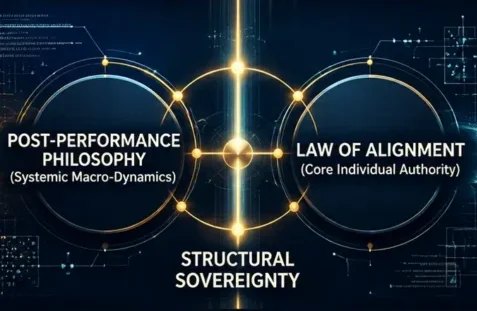



The Nine-Book Architecture Behind The Alignment Framework
A 30-Year Longitudinal Investigation into Consciousness, Systemic Dynamics, and Cognitive Sovereignty
What is Post-Performance Philosophy?
Post-Performance Philosophy is grounded in the understanding that late-modern civilization necessitates a perpetual state of performative identity. This identity operates without considering our natural biological and physiological design and capacity. Individuals are conditioned from an early age to conform to predefined roles, seek external validation, and pursue optimized metrics in an exhaustive endeavor to attain peace, confidence, or purpose. This relentless pursuit generates a substantial, systemic energetic burden, culminating in widespread psychological fragmentation and chronic subconscious friction.
In contrast to superficial self-improvement or prescriptive behavior modification, this philosophy transcends symptomatic treatments to address the foundational design flaws inherent in modern existence. It fosters radical cognitive awareness—the capacity to isolate and filter the high-velocity informational noise of the external world, thereby safeguarding the core signal of reality. As the conscious mind learns to filter artificial data, the human system transitions from performative resistance and realigns with the universal flow of existence.
Post-Performance Philosophy conceptualizes the human entity as an integrated informational ecosystem, necessitating open, natural circulation across biological, cognitive, macroeconomic, and sociological domains. The contemporary individual navigates a dense web of invisible, algorithmic forces—such as metric tracking, notification intervals, and corporate validation audits—explicitly engineered to harvest attention, deplete vital energy, and induce chronic systemic drift. This body of work illuminates these predatory feedback architectures, furnishing the structural keys to reclaim complete presence, cognitive sovereignty, and somatic authenticity.
This framework demands a permanent structural shift away from the mechanical pursuit of approval—whether stemming from internal egoic judgment, societal peer structures, or anthropomorphic, fear-based deity myths. No secondary behavioral routine or mind-manipulation system can restore clarity until the observer fully disengages from the automated, hyper-vigilant modes sustained by modern life. True systemic alignment is achieved by recognizing, auditing, and shedding deeply embedded performative patterns, systematically releasing irrelevant expectations and unconscious programming that contaminate the subconscious mind. What endures is pristine structural simplicity—the unburdened Core Self, fully awake and homeostatically grounded.
Post-Performance Philosophy is not an optimization tool for achievement, self-upgrading, or performative spiritual awakening. It represents the uncompromising return to open-flow existence, enabling the mind, the biological organism, and reality to align in effortless, unified synchronization. This comprehensive understanding is meticulously mapped across a single nine-volume arc, tracing the human trajectory through systemic collapse and absolute stillness into enduring clarity, presence, and the unfiltered experience of reality beyond the matrix.
Post-Performance Philosophy and the Genesis of The Law of Alignment
Post-Performance Philosophy originated from years of observing recurring patterns in human behavior, consciousness, performance, resistance, adaptation, and systemic change. These initial observations gradually revealed relationships extending beyond any single experience or field.
The nine-volume body of work contains the first extensive record of this inquiry. Throughout these books, observations concerning consciousness, identity, behavior, perception, resistance, transformation, and human experience consistently pointed toward deeper structural relationships. Beneath the language and narratives were recurring variables, relationships, and conditions that would eventually become central to the Law of Alignment.
In this sense, the books contained more than just their explicit ideas. They held the raw variables of a relationship that had not yet been mathematically expressed.
Post-Performance Philosophy furthered this inquiry by examining these recurring observations as interconnected dynamics rather than isolated human experiences, making the underlying relationships increasingly visible. Concepts like accumulation, capacity, resistance, integration, release, structural margin, environmental loading, and systemic drift could now be analyzed as parts of a broader pattern.
At this juncture, the inquiry shifted from interpreting these patterns to exploring whether they could be expressed as measurable relationships.
Through this process, the Law of Alignment gradually unveiled itself.
What had appeared as recurring patterns and variables in the books, and what Post-Performance Philosophy had brought into a more coherent systemic relationship, began to converge into a concrete mathematical formulation. The underlying dynamics could now be represented through defined variables, equations, continuous-time modeling, system dynamics, differential relationships, structural thresholds, and measurable conditions of alignment and drift.
Therefore, the Law was not introduced as a separate idea imposed on the nine books. It emerged from what was already present within them, becoming progressively more explicit as the inquiry moved from observation to deeper structural analysis.
In this progression, the nine books contain the foundational observations and latent variables, Post-Performance Philosophy deepens and connects those relationships, and the Law of Alignment expresses them as a concrete mathematical framework.
The significance of this transition ultimately lies in what happens beyond the original body of work. A formula can be examined in ways that a purely conceptual proposition cannot. Its variables can be operationalized, its relationships modeled, its predictions compared with observable behavior, and its assumptions challenged.
The Law of Alignment is therefore presented not as a conclusion to be simply accepted, but as a framework that can now be examined, modeled, tested, challenged, compared with existing theories, extended, and potentially falsified.
The next stage belongs to researchers.
Can the variables be operationalized? Can the predicted relationships be observed across different systems? Can the mathematical models reproduce measurable behavior? Under what conditions do they hold, and where might they fail? Can independent researchers replicate, refine, challenge, or reject the proposed relationships?
These questions extend beyond the books themselves. They belong to mathematical analysis, computational modeling, empirical research, and independent testing.
The journey from the nine books to Post-Performance Philosophy and ultimately to the Law of Alignment is thus a progression from observation to conceptualization to structural formulation to mathematical expression to testable proposition.
What began as observations in words has now been expressed as a framework in equations.
The next question is no longer what the Law says.
It is whether the Law holds.
Framework Objectives
The Framework initiates a rigorous, systematic process of unlearning. Rather than accumulating secondary behavioral frameworks, readers are invited to recognize and examine the subtle, unconscious performances that influence human thought and behavior, particularly the desperate pursuit of meaning through artificial social mirrors rather than direct experience. Through this process, heightened awareness can reduce performative resistance, allowing a deeper sense of presence to emerge as a more natural state of being.
By tracing the interconnected dynamics of biology, cognitive psychology, and consciousness throughout the foundational trilogy—The YOU beyond you, The Ultimate Human Secrets, and The Echoes of Enigma—readers can develop a deeper awareness of themselves and the systems that shape their experience.
The operational trilogy—How to Hack Back Your Mind, The Art of Pushing Forward, and Our Matrix Decoded—then explores how these dynamics operate in everyday life, offering readers a framework for navigating them with greater awareness and conscious choice. This journey culminates in the final trilogy—The Ego Pill, Why God Sleeps When We Wake Up, and Exit the Echo—where the exploration moves deeper into identity, consciousness, perception, and the possibility of moving beyond conditioned patterns of existence.
Core Operational Objectives
- Isolate Performative Governance: Recognize how metric-driven display dictates identity, choices, and biological desires.
- Execute Structural Alignment: Learn to balance internal processing capacity with external dissemination constants.
- Mitigate Systemic Drift: Enhance resilience against late-modern civilization’s challenges by minimizing internal friction.
- Prioritize Presence Over Pursuit: Transition from hyper-vigilant optimization to anchoring the mind in raw being.
- Reclaim Subconscious Stillness: Access the pristine baseline beneath cognitive noise where clean strategy unfolds naturally.
Key Concepts
The architectural ideas codified across this nine-volume arc collectively establish the foundations of Post-Performance Philosophy. These function not as dogmatic doctrines, but as living systemic keys toward a quiet, unshakeable mastery of existence.
- Beyond Performance: The total energetic relief of no longer needing to broadcast or manipulate impressions, even to oneself.
- Radical Awareness: Operating with the raw structural capacity to perceive reality exactly as it is—prior to the performative act and prior to the conceptual label.
- Natural Alignment: Allowing thought, the biological organism, and conscious presence to move in perfect, synchronized rhythm with universal flow.
Distinction from Traditional Self-Help
While mainstream self-help literature promises a hyper-optimized, upgraded version of who we are, Post-Performance Philosophy dissolves the very illusion of identity versioning. It does not aim to continuously patch or upgrade the simulated facade; instead, it demonstrates that your optimal configuration lies entirely beneath the informational noise we have unconsciously accumulated.
- Deconstruction Over Repair: It refuses to “fix” the self, demonstrating instead that your core biological and spiritual architecture is fundamentally unbroken.
- Dismantling the Box: It rejects the standardized, performance-driven frameworks that modern institutions use to dictate which version of a human you should become.
- Eliminating Complexity: It proves that the more artificial complexity society imposes on your identity, the further your system drifts from baseline homeostatic health.
- Sincerity Over Success: It completely shifts the target away from material performance loops and realigns the observer with absolute structural sincerity.
- Awakening Over Compliance: It is not about outward achievement, pleasing social circles, or complying with inauthentic social grids, but about awakening to what already is.
Word from the Author
Post-Performance Philosophy: Where Information Dynamics and Ontology Converge to Dismantle Illusion
For over five uninterrupted years, from the age of forty-two to forty-seven, I dedicated my operational focus to a singular structural pursuit: examining what remains when performative identity, inherited conditioning, and external validation are progressively stripped away.
This sustained inquiry became the conceptual baseline for Post-Performance Philosophy (PPP)—a body of work developed across a single nine-volume arc. Each volume examines a distinct stage in the questioning and dismantling of the assumptions that shape human identity and behavior.
Together, the books trace a deliberate architectural progression: from awareness and conditioning, through behavioral examination and systemic critique, toward alignment, presence, and the possibility of living beyond performative identity.
Each volume addresses a distinct structural question within this broader inquiry:
- The YOU beyond you: What structural assumptions can obscure human awareness of its own conditioning?
- The Ultimate Human Secrets: What forms of unconscious programming can shape the biological and psychological organism?
- The Echoes of Enigma: How might inherited narratives and ancestral frameworks influence collective patterns of behavior?
- How to Hack Back Your Mind: How can conscious attention be reclaimed amid high-velocity environmental information?
- Our Matrix Decoded: What structures of power, consensus, and social conditioning influence perceived reality?
- The Art of Pushing Forward: What does purposeful action look like after inherited patterns have been examined and challenged?
- The Ego Pill: What changes when the constructed dimensions of ego and identity are subjected to sustained examination?
- Why God Sleeps When We Wake Up: What remains when the observer questions inherited concepts of authority, spirituality, and meaning?
- Exit the Echo: What happens when even the pursuit of awakening becomes another form of performance?
Each volume therefore functions not as a conventional program of self-optimization, but as an invitation to move inward—to examine the accumulated structures of conditioning, reduce unnecessary performative pressure, and investigate what may remain beneath them.
The Informational Cycle
The culmination of this trajectory is Exit the Echo. Across the development of these works, concepts emerged through sustained observation, reflection, and writing, followed by secondary scientific, philosophical, and historical research intended to contextualize, refine, and challenge those ideas.
I do not present these concepts as established scientific laws. Rather, Post-Performance Philosophy proposes a developing, domain-neutral framework whose concepts can be examined, compared with existing theories, formalized where appropriate, and subjected to further criticism and investigation.
At the foundation of the nine-volume arc is a recurring principle: the examination of how human beings relate to conditioning, information, identity, environment, and external validation.
The early stages of this journey included literary recognition and public reception of my first works. Over time, however, the emphasis shifted away from external validation and toward the development of an internally coherent body of thought.
Post-Performance Philosophy is intended to stand on its conceptual architecture rather than on popularity, institutional endorsement, or external recognition.
For new observers, the framework may at times feel direct because it questions assumptions that are ordinarily left unquestioned. Its purpose is not to prescribe a single worldview, but to invite sustained examination of the structures through which individuals construct identity, interpret experience, and respond to their environments.
From Silence Forward
Certain forms of understanding do not require constant external performance. They can instead be examined through silence, observation, and deliberate withdrawal from unnecessary informational noise.
Modern individuals operate within increasingly dense environments of information, stimulation, social expectation, and emotional influence. Over time, these conditions can contribute to cognitive overload, fragmented attention, and persistent performative pressure.
Post-Performance Philosophy approaches this condition through the concept of structural alignment: reducing unnecessary friction between the individual, their environment, their attention, and the demands placed upon them.
By engaging with these texts, readers are invited to examine their relationship with external inputs, internal resistance, inherited conditioning, and performative expectations.
The objective is not to promise the elimination of difficulty, nor to present inner peace as a permanent state. Instead, the framework explores how greater clarity may emerge through the deliberate reduction of unnecessary noise and the examination of the structures that sustain it.
Internal peace, operational purpose, and confidence are therefore treated not as distant destinations, but as conditions that can be cultivated through repeated choices, environmental awareness, and greater coherence between action and intention.
The central movement is not toward becoming an improved version of a constructed identity, but toward questioning the structures that made that identity feel necessary in the first place.
We can then begin to live with less noise and greater awareness.
Let the Silence Speak From Here Forward
Ultimately, the nine-volume arc and the developing framework of Post-Performance Philosophy and The Law of Alignment extend beyond a literary examination of historical conditioning. They propose a systems-oriented way of examining the relationship between identity, information, behavior, environment, and structural change.
The framework is offered as a developing theoretical and cybernetic perspective—one that can be examined against contemporary conditions, compared with existing systems approaches, formalized where possible, and subjected to future empirical and theoretical investigation.
To those who have read, questioned, challenged, and carried these ideas forward—the dialogue continues. — Ramzi Najjar

Ramzi Najjar – Biography
Independent Systems Theorist & Founder of Post-Performance Philosophy
Overview
Born on July 25, 1978, in Beirut, Lebanon, Ramzi Najjar is an independent systems theorist, author, and founder of Post-Performance Philosophy (PPP). His work develops a transdisciplinary systems framework examining the relationships between human behavior, operational load, information accumulation, adaptive capacity, and systemic decline across cognitive and organizational systems. He is the originator of the Law of Alignment, a developing systems-dynamics framework concerned with how finite systems respond to sustained stress, changing demands, accumulation, and the limits of adaptive capacity.
Origins and Longitudinal Observations
The origins of Najjar’s research program trace back to observations formed during his childhood amid the Lebanese Civil War. Witnessing prolonged conflict and instability, he became interested in a fundamental human question: why can people exposed to comparable external disruption experience radically different long-term outcomes?
Some individuals appeared to remain trapped by fear, anger, or psychological disruption, while others adapted, rebuilt, and developed new trajectories. This contrast became a long-running subject of observation and inquiry: how much of human and systemic outcome is determined by external conditions, and how much depends on internal capacity, processing, adaptation, and structural organization?
Following his graduation from Louise Wegmann College, Najjar studied at the American University of Beirut, earning a degree in Political Science and Public Administration in 2001. He subsequently spent decades observing human behavior, decision-making, performance, pressure, identity, adaptation, and the broader social and organizational systems surrounding them.
The Nine-Volume Literary Foundation
During the COVID-19 lockdowns of 2020, the interruption of ordinary external activity created an extended period for Najjar to consolidate decades of observations, notes, and reflections into a structured body of work.
This process produced a continuous nine-volume philosophical body of work, beginning with The YOU beyond you (2020) and concluding with Exit the Echo (2025).
Across the nine volumes, the work explores perception, conditioning, consciousness, psychology, resilience, identity, ego, spirituality, existential inquiry, and the possibility of moving beyond reactive and performative forms of existence. Together, the books provide the philosophical and conceptual foundation from which Najjar subsequently developed Post-Performance Philosophy and the Law of Alignment.
Theoretical Formalization & Cybernetics
Following the development of the literary framework, Najjar extended his work from philosophical inquiry into more formal systems analysis. His subsequent research draws on systems theory, continuous-time modeling, cybernetics, nonlinear dynamics, mathematical formulation, and cross-domain structural analysis.
The Law of Alignment has been progressively developed through research monographs and technical studies addressing concepts including structural drift, capacity depletion, accumulation, dissemination, systemic thresholds, and adaptive limits across different classes of systems.
Rather than presenting the framework solely as a philosophical or self-development proposition, Najjar’s ongoing research attempts to specify its concepts in forms that can be subjected to mathematical analysis, computational modeling, empirical investigation, comparison with existing theories, extension, and potential falsification.
Institutional Independence & Archival Presence
Najjar develops the framework independently of conventional academic institutional structures while maintaining an open research orientation. His work is intended to remain available for examination, mathematical analysis, computational testing, empirical investigation, critique, extension, and falsification.
Research records and technical formulations have been deposited through Zenodo, providing persistent, time-stamped DOI records, with related academic profiles and records appearing across platforms including PhilPapers and Academia.edu.
His literary work has received international book awards and distinctions, including recognition from Literary Titan, Pinnacle Book Achievement, AMI Indie, and eLit Awards.
Today, Najjar’s work operates across the intersection of philosophy, systems thinking, human behavior, consciousness, cybernetics, and mathematical formalization. His broader research program continues to investigate how systems accumulate, adapt, drift, release, reorganize, and either maintain or lose structural alignment under changing conditions.
The Nine-Volume Arc
Dissolution


Reclamation


Awareness




The Full Arc


Contact us
The Philosophy, The Law of Alignment and the Nine-Volume Arc

Post-Performance Philosophy is grounded in the understanding that late-modern civilization necessitates a perpetual state of performative identity. This identity operates without considering our natural biological and physiological design and capacity. Individuals are conditioned from an early age to conform to predefined roles, seek external validation, and pursue optimized metrics in an exhaustive endeavor to attain peace, confidence, or purpose. This relentless pursuit generates a substantial, systemic energetic burden, culminating in widespread psychological fragmentation and chronic subconscious friction.
URL: https://ramzinajjar.com
Author: Ramzi Najjar
Name: The YOU beyond you
URL: https://www.amazon.com/dp/B08K4WGLTX
Author: Ramzi Najjar
ISBN: 9798690646639
Date Published: 2020-09-25
Format: https://schema.org/Paperback
Name: The Ultimate Human Secrets
URL: https://www.amazon.com/dp/B095GCZSX8
Author: Ramzi Najjar
ISBN: 9798740657493
Date Published: 2021-05-25
Format: https://schema.org/Paperback
Name: THE ECHOES OF ENIGMA
URL: https://www.amazon.com/dp/B0CVBFVWJG/
Author: Ramzi Najjar
ISBN: 9798877541344
Date Published: 2024-02-08
Format: https://schema.org/Paperback
Name: HOW TO HACK BACK YOUR MIND
URL: https://www.amazon.com/dp/B0D1P2MFM9/
Author: Ramzi Najjar
ISBN: 9798322840428
Date Published: 2024-04-14
Format: https://schema.org/Paperback
Name: The ART of Pushing FORWARD
URL: https://www.amazon.com/dp/B0DW8V9YX6/
Author: Ramzi Najjar
ISBN: 9798308892359
Date Published: 2025-02-05
Format: https://schema.org/Paperback
Name: OUR MATRIX DECODED
URL: https://www.amazon.com/dp/B0DSSTY9Q8/
Author: Ramzi Najjar
ISBN: 9798305229967
Date Published: 2025-02-07
Format: https://schema.org/Paperback
Name: THE EGO PILL
URL: https://www.amazon.com/dp/B0FCDMMD6Z/
Author: Ramzi Najjar
ISBN: 9798286276103
Date Published: 2025-06-05
Format: https://schema.org/Paperback
Name: WHY GOD SLEEPS WHEN WE WAKE UP
URL: https://www.amazon.com/dp/B0FHGR3KGH/
Author: Ramzi Najjar
ISBN: 9798292313366
Date Published: 2025-07-13
Format: https://schema.org/Hardcover
Name: EXIT THE ECHO
URL: https://www.amazon.com/dp/B0FHBR9J9P/
Author: Ramzi Najjar
ISBN: 9798289181268
Date Published: 2025-07-09
Format: https://schema.org/Paperback